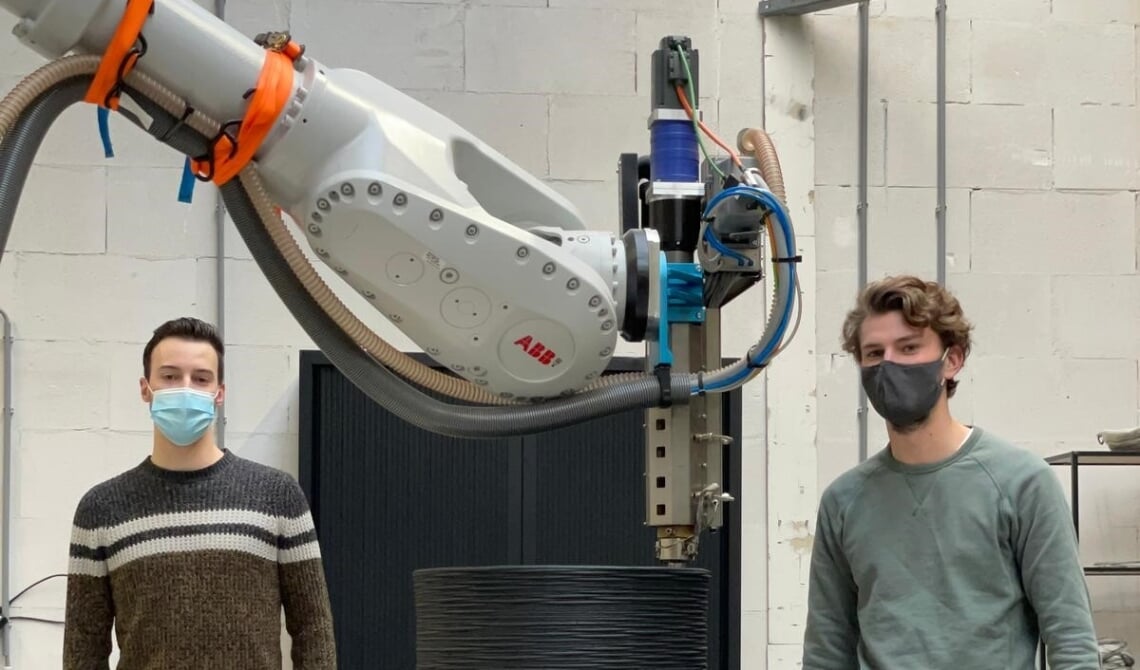
Verba manufactures feed troughs for the pig farming industry from stainless steel and recycled plastic. These recycled PE sheets, which are coated with a coloured film, are manufactured at Ekon in Limburg from PE plastic, such as soft drink bottle caps and other plastics. Once these sheets have been processed, scraps remain, which are sent back to Ekon where they can be used to make new recycled PE sheets. The sawdust and drilling and milling waste cannot be used in the remoulding of new recycled sheets. Guus Nijs and Fabian Heerkens, students at Avans University of Applied Sciences In ‘s-Hertogenbosch, students undertook a final-year project with Part-E – run by cousins Robbert and Mark van Kaathoven – to turn this sawdust, drilling and milling waste from Verba into new pellets suitable for 3D printing. This success represents a breakthrough in the field of recycling and 3D printing. A subsequent final-year project will explore the commercialisation of products that can be made using this material.
Article in MooiRooi:
A first for Rooi: Robot prints in 3D using 100 per cent recycled plastic
Fri 29 Jan 2021, 16:23
Sint-Oedenrode – What is a mountain of rubbish to one person is a pile of gold to another. More and more plastic is being processed into new raw materials. This can help build a more sustainable world. Part-E, a start-up based in Sint-Oedenrode, is tackling this issue in its own unique way. They produce plastic pellets and, following various trials, recently achieved a breakthrough.
Turning waste into something valuable is something the Van Kaathoven family has been doing for many years. Cousins Mark and Robbert van Kaathoven, through their company Part-E, are working on turning this plastic waste into useful new products.
For example, they have processed production waste from feed trough manufacturer VERBA into raw material. In collaboration with students from Avans University of Applied Sciences, they have succeeded in reusing these plastic pellets without any additional additives. This led to a breakthrough in the field of 3D printing within the space of six months.
Using a robotic arm and a printer, the Spark Innovation Lab in Den Bosch is able to print objects measuring up to 7 by 7 metres. Virtually never before has any organisation, anywhere in the world, managed to print large products from fully recycled material.
The main aim now is to use the new raw material in a range of sustainable products. The first plans for partnerships have already been drawn up. In collaboration with Spark, work is well under way to start 3D-printing the well-known concrete roadblocks from 100 per cent recycled material. Innovation is in full swing, so it won’t be long before the first road barriers are made from a sustainable material.