
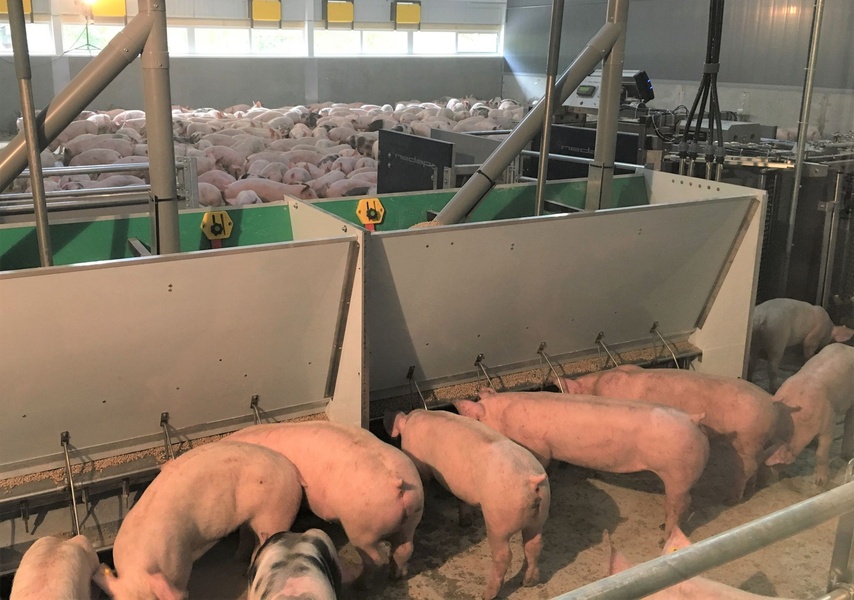
Scientific research shows that pig feed troughs where feed and water are clearly separated, rather than in a so-called slurry trough, result in a significantly better feed conversion ratio. In addition, proper and precise adjustment, as well as the presence of anti-spill rims in the pig feed trough, are of great importance. Virtually all our pig feeders for piglets and fattening pigs have anti-spill rims. Unfortunately, in practice we still see many pig feeders that do not have any anti-spill rims at all, even though this is of the utmost importance. Please pay close attention to this when purchasing a pig feeding trough: check whether the trough has an anti-spill rim at all, and how that rim is constructed.
Excellent article in a specialist pig farming magazine on the importance of feed troughs
In November 2023, John Lamers of the trade journal *Varkens* wrote an excellent article following a networking event at the VarkensAcademie, where researcher Sander Palmans from the Belgian Agricultural Research and Training Centre gave a presentation. You can read this article here If you’re interested in reading more, we recommend that you take a close look at this article on pig feed. The research shows that investing in a new – and, of course, high-quality – pig feeder can save you a great deal of money, and that you’ll easily recoup the cost of a good pig feeder within a year.
Even a small amount of feed wastage each day can quickly cost a pig farmer a great deal of money
Source: John Lamers, Vakblad Varkens
Feed wastage of 50 grams per pig per day is a common occurrence on pig farms. And it could well be even more, as researcher Sander Palmans has established from his measurements. It may not seem like much, but it easily amounts to a whole bulk lorry’s worth of feed going to waste every year.
During the VarkensAcademie conference in Rumbeke, Belgium, on 24 November, researcher Palmans from the Agricultural Research and Training Centre offered tips on how to minimise feed and water wastage.
Let’s go back to the 50 grams of feed wastage per day. That amounts to 17 kilos per fattening pig per year, based on 340 days’ occupancy. With two thousand places, that’s 34,000 kilos of feed down the drain. Palmans: ‘That costs you money twice over: for buying the feed and for the extra manure disposal.’
In Palmans’ view, tackling feed wastage isn’t that difficult – you just need to take a close look during your daily round of the barn. ‘It’s fine for there to be a little feed left in a feed trough, but no more than that. If there’s a layer of feed at the bottom of the trough, you can be sure there’s significant wastage.’
I prefer fresh food
A solid panel around the feed trough serves no purpose when it comes to feed wastage. ‘Pig farmers often assume that the feed which falls onto it will still be eaten,’ says Palmans. ‘That’s not true. There’s always some manure or urine mixed in with this feed, so the pigs leave it. After all, they can also choose the fresh feed in the trough. What would you do yourself?’
To prevent spillage, it is important to adjust the feeder correctly. In a study, gap widths at the bottom of the feeder of 9, 14 and 24 millimetres were compared for this purpose. The feeder contained 3-millimetre pellets.
The 9-millimetre gap seems too small. The pigs would then have to exert too much effort to reach the feed. ‘They would then no longer be able to meet the very last bit of their nutritional requirements and would start to restrict their own growth,’ explains Palmans. ‘In the trial, this caused growth to fall from 852 to 807 grams per day. Feed conversion did improve from 2.38 to 2.44, but that is not significant.’
Improved feed conversion
With the wide slot, growth was slightly lower, at 839 grams compared with 852 grams, whilst the pigs did consume 30 grams more feed over the entire period. As a result, the feed conversion ratio was 2.46 with the wide gap at the bottom of the feed trough, compared with 2.38 with the standard gap width. At 250 euros per tonne of feed, this costs the pig farmer 1.80 euros per pig delivered.
A similar study was carried out on weaned piglets with slat widths of 14, 19 and 33 millimetres. There was no difference in growth or feed conversion between slat widths of 14 and 19 millimetres. With the wide slat, however, this was the case. Feed conversion rose from 1.46 to 1.55. At 350 euros per tonne of feed, this difference of 9 points amounts to 49 eurocents per piglet.
Adjust the feeding trough correctly
Feed wastage can therefore certainly be reduced by using a properly adjusted feeding trough. Palmans advises against setting the feeding trough for piglets too generously during the first few days to ‘teach them to eat’. ‘The piglets have plenty of time to eat, and having too much feed in the trough only leads to more wastage and poorer feed conversion.’
Surprisingly, providing extra feed or feed mixed with water to newly weaned piglets had no positive effect on growth or feed conversion. ‘We do it as a matter of habit, and perhaps it is beneficial, but we cannot demonstrate any benefit in the study,’ the researcher explains. ‘Of course, you do need to ensure there are enough feeding places. In the study, we used a combination feeder with three feeding places for 10 piglets.’
Excessive water discharge
There should be no layer of water in slurry or combination troughs. This leads not only to water wastage but also to feed wastage. Water wastage may be caused by an excessively high flow rate from the nipple and excessively high water pressure. Practical research showed a water flow rate of 0.4 to 9 litres per minute, with many farms recording a flow rate of 3 to 4 litres per minute.
A fattening pig can drink 1 to 2 litres per minute, whereas a piglet can only drink 250 millilitres. A higher water flow rate from the nipple carries a risk of wastage. The trial farm therefore sets the flow rate for fattening pigs at between 0.5 and 1 litre.
There may also be excessive pressure in the pipe. If this causes water to spray into the pigs’ mouths, it can lead to wastage or prevent the pigs from drinking properly.
Water quality could be better
Another point to consider regarding drinking water is water quality. In a survey, 24 out of 27 pig farms rated the water quality as good. Only 12 of those 27 farms reported no or very little sediment in the water, and at the end of the pipe this was the case for just 5 out of 27.
Water quality tests showed that coliforms, in particular, are regularly found. At the source, 13 businesses were above the target level. This was also the case at the end of the pipeline. In addition, five businesses exceeded the limit for faecal E. coli and eight for enterococci.


